
0 guardado
Entra en la escena
Your living room, a month before you fly
Can you say it in one breath?
A friend asks you at dinner: "So what do you actually do in Umrah?" You want to answer clearly, in order, without notes.
Lee
Four acts, one morning

Every Umrah is the same four acts, in this order:
- Ihram at or before the miqat: the intention and the talbiyah.
- Tawaf: seven rounds round the Ka'bah, then two rak'ahs.
- Sa'i: seven lengths between Safa and Marwah.
- Halq or taqsir: shaving or shortening the hair.
Then you leave ihram. Learn them as a chain: each act opens the next.
Ordena
Put Umrah in order
Ponlos en el orden correcto.
- Ihram: intention and talbiyah
- Tawaf: seven rounds
- Sa'i: seven lengths
- Halq or taqsir
Ver la respuesta
Ihram opens the Umrah, tawaf is its heart, sa'i follows the tawaf, and cutting the hair closes it.
Lee
1. Ihram, the doorway

Ruling: a condition (shart). Without it there is no Umrah.
Before the miqat: ghusl, the ihram clothes, two rak'ahs if it is not a disliked time. Then the intention with the talbiyah: the two together begin ihram.
From then on, perfume, cutting hair and nails, and (for men) stitched clothes and covering the head are forbidden.
Lee
2. Tawaf, the heart

Ruling: four of the seven rounds are the pillar (rukn); the last three are wajib. Wudu is wajib too.
Start at the Black Stone, the Ka'bah on your left. Men uncover the right shoulder (idtiba') for the whole tawaf and walk briskly (raml) in the first three rounds.
Stop the talbiyah as you begin. After the seventh round, pray two rak'ahs (wajib).
Verdadero o falso The talbiyah in tawaf
In Umrah, the talbiyah carries on through all seven rounds of tawaf.
Ver la respuesta
False. For Umrah the talbiyah stops as you begin tawaf, at the Black Stone. Your tongue moves on to dua and dhikr.
Lee
3. Sa'i, the walk of Hajar
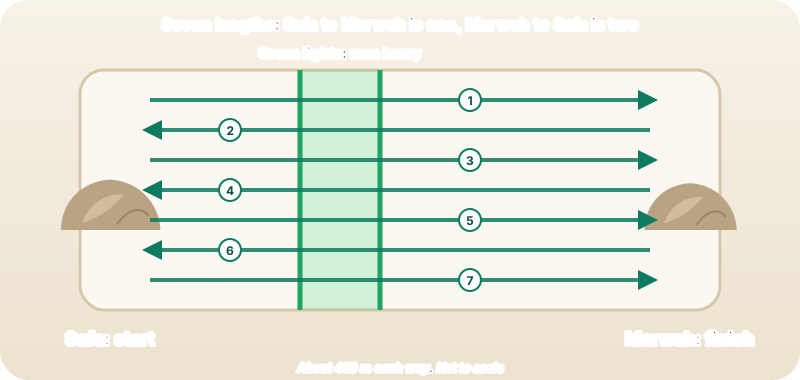
Ruling: wajib. Seven lengths: Safa to Marwah is one, Marwah back to Safa is two, and you finish at Marwah.
Climb Safa a little, face the Ka'bah, raise your hands as in dua and praise Allah. Men jog gently between the green lights; women walk.
Wudu is good but not required for sa'i. It must come after a tawaf.
Lee
4. Halq or taqsir, the release
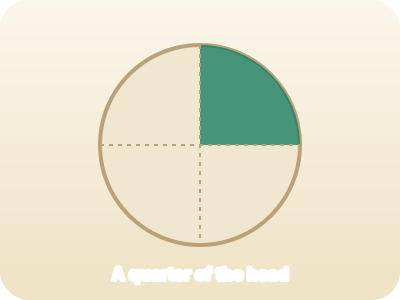
Ruling: wajib. Men shave the head (best) or cut at least a fingertip's length from at least a quarter of it; cutting the whole head is better.
Women cut a fingertip's length from the ends of their hair, never shaving.
It is done inside the Haram area. After it, everything forbidden by ihram is allowed again.
Clasifica
What rank is each act?
Sort each part of Umrah by its ruling.
Condition or pillar
- The intention with the talbiyah
- Four rounds of tawaf
Wajib
- The last three rounds
- Sa'i
- Shaving or shortening
Sunnah
- Raml in the first three rounds
- Ghusl before ihram
Lado a lado
What a missed part costs
| Rank | If it is missed |
|---|---|
| Condition or pillar | The Umrah is not done. Do it; until then you stay in ihram. |
| Wajib | Usually a sheep (damm) sacrificed in the Haram, unless you make it up in time. |
| Sunnah | No penalty; only the reward is lost. |
Del hadiz
Learn your rites
عَن جَابر قَالَ: رَأَيْتُ النَّبِيَّ صَلَّى اللَّهُ عَلَيْهِ وَسَلَّمَ يَرْمِي عَلَى رَاحِلَتِهِ يَوْمَ النَّحْرِ وَيَقُولُ: «لِتَأْخُذُوا مَنَاسِكَكُمْ فَإِنِّي لَا أَدْرِي لَعَلِّي لَا أَحُجُّ بعد حجتي هَذِه» . رَوَاهُ مُسلم
Jabir said he saw the Prophet throwing pebbles on the day of sacrifice while on his riding-beast and saying, “Learn your rites, for I do not know whether I am likely to perform the pilgrimage after this occasion.” Muslim transmitted it.
Lee
Why learn it now

At the Jamarah the Prophet ﷺ told the people to learn their rites from him, because he might not make Hajj with them again. Scholars took from this that a pilgrim learns the rites before doing them.
Many mistakes in Umrah come from people copying the person in front of them. Know the four acts and their rulings, and you will know what to do when the crowd does something else.
Lee
A morning, hour by hour

Here is how one Umrah often runs, arriving the night before:
- After Fajr: tawaf, about 45 to 90 minutes, with the two rak'ahs and Zamzam.
- A short rest, then sa'i, about 45 to 60 minutes.
- At a barber near Marwah, or in the hotel: the haircut, 15 minutes.
Crowds change everything, so leave space in the day. Nothing in Umrah needs to be rushed.
¿Qué harías?
Arriving at 2 a.m.
Your flight lands late. You reach the hotel in ihram at 2 a.m., exhausted. Your group leader says: "Rest. We do Umrah after Fajr." Is that fine?
- Yes, rest firstRight. There is no deadline for tawaf once you are in ihram.
- No, Umrah must be done the moment you arriveThere is no such rule. A rested pilgrim worships better.
Revelar
Common mix-ups
Flip each card to see the truth.
- "Ihram means the white clothes." The clothes are its dress. Ihram itself is the intention with the talbiyah.
- "After tawaf, Umrah is finished." Not yet: sa'i and cutting the hair remain.
- "Keep saying the talbiyah in tawaf." For Umrah it stops as you begin tawaf, at the Black Stone.
- "Women shave a little too." Women never shave; they cut a fingertip's length.
Verdadero o falso The last step
After sa'i you may take off ihram and cut your hair later at home.
Ver la respuesta
False. You stay in ihram until the hair is cut, and it is cut inside the Haram area.
Lección terminada
Umrah at a glance: four acts and their rulings
Has añadido un paso de la ruta a la ruta de un peregrino por La Meca, Mina y Arafa.
Lo que aprendiste
- Ihram (condition), tawaf (pillar: four rounds), sa'i (wajib), halq or taqsir (wajib).
- A wajib left usually costs a sheep; a sunnah left costs only reward.
- Learn the rites before you go, so the crowd does not teach you.
- hechos
- 0
- bien a la primera
- 0
- para repasar
- 0
Tu obra · Pruébalo hoy
Say the four acts of Umrah aloud, in order, with the ruling of each, to someone at home.
Lo que guardaste
Inicia sesión para guardar tu progreso en todos tus dispositivos.