
0 guardado
Entra en la escena
A family home, the week after a funeral
The week after the funeral
The family wants to “share out the money” at once. Four things come before any heir.
Mira
The week after the funeral

Yusuf’s father has died. The family wants to “share out the money” at once. The imam gently stops them: “Three things come first.”
Lee
What is in the estate
Everything the person owned at death: bank accounts, cash, gold, a house or a share in one, a car, shares, a business, and money others owed them.
Gifts they completed while alive are not in it. Pension death benefits and life insurance paid to a named person have their own questions: ask a scholar with the documents.
Make a list now of your accounts, property and debts, and tell one trusted person where it is. It saves your family months of searching.
Lee
The wife's unpaid mahr

If a husband never paid his wife's mahr, or only part of it, the rest is a debt. It is paid from the estate with the other debts, before any will and before the shares.
After that, she also takes her share as his wife. The two are separate: one is a debt owed to her, the other her inheritance.
A widow should not feel shy to mention an unpaid mahr: it is her right and the deceased's debt, and paying it frees him.
Encuéntralos
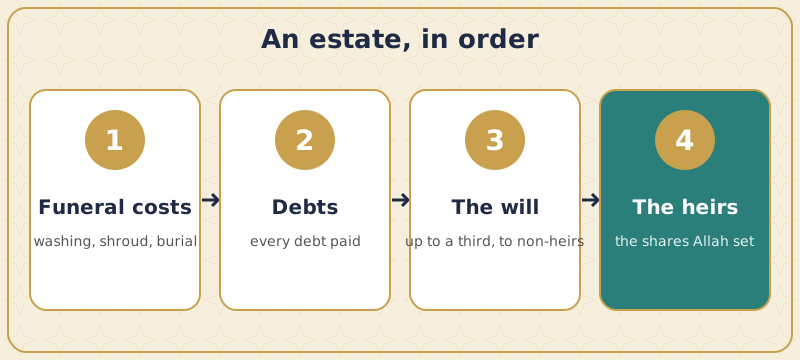
An estate, in order
Tap the picture to find each part. Each one opens a card.
- Funeral costs Washing, shroud and burial, at a moderate cost, from the estate.
- Debts Every debt is paid: loans, bills, unpaid mahr to a wife.
- The will Up to a third of what is left, to people who are not heirs or to good causes.
- The heirs Everything remaining is divided by the shares Allah set.
Del hadiz
Debts before the will
وَعَنْ عَلِيٍّ رَضِيَ اللَّهُ عَنْهُ قَالَ: إِنَّكُمْ تقرؤون هَذِهِ الْآيَةَ: (مِنْ بَعْدِ وَصِيَّةٍ تُوصُونَ بِهَا أَو دين) وَإِنَّ رَسُولَ اللَّهِ صَلَّى اللَّهُ عَلَيْهِ وَسَلَّمَ قَضَى بِالدّينِ قبل الْوَصِيَّةِ وَأَنَّ أَعْيَانَ بَنِي الْأُمِّ يَتَوَارَثُونَ دُونَ بَنِي الْعَلَّاتِ الرَّجُلُ يَرِثُ أَخَاهُ لِأَبِيهِ وَأُمِّهِ دُونَ أَخِيهِ لِأَبِيهِ ". رَوَاهُ التِّرْمِذِيُّ وَابْنُ مَاجَهْ وَفِي رِوَايَةِ الدَّارِمِيِّ: قَالَ: «الْإِخْوَةُ مِنَ الْأُمِّ يَتَوَارَثُونَ دُونَ بَنِي الْعَلَّاتِ. . .» إِلَى آخِره
‘Ali said: You recite this verse, “After a legacy you bequeathe or a debt (Al-Qur’an 4:12),’’ but God’s Messenger decided that a debt should be discharged before a legacy and that the sons of the same mother inherit from one another, but not the sons of one father by different mothers. A man inherits from his brother who has the same father and mother, but not from his brother who has the same father but a different mother. Tirmidhi and Ibn Majah transmitted it. In a version by Darimi he said, “Brothers who have the same mother inherit from one another but not sons of the same father but of different mothers, etc."
Del hadiz
A third is a lot
وَعَنْ سَعْدِ بْنِ أَبِي وَقَّاصٍ قَالَ: مَرِضْتُ عَامَ الْفَتْحِ مَرَضًا أَشْفَيْتُ عَلَى الْمَوْتِ فَأَتَانِي رَسُولُ اللَّهِ صَلَّى اللَّهُ عَلَيْهِ وَسَلَّمَ يَعُودُنِي فَقُلْتُ: يَا رَسُولَ اللَّهِ: إِنَّ لِي مَالًا كَثِيرًا وَلَيْسَ يَرِثُنِي إِلَّا ابْنَتِي أَفَأُوصِي بِمَالِي كُلِّهِ؟ قَالَ: «لَا» قُلْتُ: فَثُلُثَيْ مَالِي؟ قَالَ: «لَا» قُلْتُ: فَالشَّطْرِ؟ قَالَ: «لَا» قُلْتُ: فَالثُّلُثِ؟ قَالَ: «الثُّلُثُ وَالثُّلُثُ كَثِيرٌ إِنَّكَ إِنْ تَذَرْ وَرَثَتَكَ أَغْنِيَاءَ خَيْرٌ مِنْ أَنْ تَذَرَهُمْ عَالَةً يَتَكَفَّفُونَ النَّاسَ وَإِنَّكَ لَنْ تُنْفِقَ نَفَقَةً تَبْتَغِي بِهَا وَجْهَ اللَّهِ إِلَّا أُجِرْتَ بِهَا حَتَّى اللُّقْمَةَ تَرْفَعُهَا إِلَى فِي امْرَأَتِكَ»
Sa‘d b. Abu Waqqas said : During an illness which brought me near to death in the year of the Conquest God’s Messenger came to visit me and I said, “Messenger of God, I have a large amount of property and my daughter is my only heir. Shall I will away all my property ?” He replied, ‘No” I suggested two-thirds, but he objected, then a half, but he still objected. When I suggested a third he replied, “You may will away a third, but that is a lot*. To leave your heirs rich is better than to leave them poor and begging from people. You will not spend anything, seeking thereby to please God, without being rewarded for it, even the mouthful you give your wife.” *While this tradition tells that the Prophet gave permission for a man to will away a third of his estate to some person or purpose other than the heirs, it indicates that be thought it would be better not to will away so much. (Bukhari and Muslim.)
Mira
What these teach
Debts are paid before any bequest. And the Prophet ﷺ limited a will to a third, and even called a third a lot: leaving your heirs well off is better than leaving them in need.
Calcúlalo
Before the heirs
Work through the four steps in order.
- Everything he left
- Funeral costs
- Debts
- Bequests in his will (to non-heirs)
- 1. After funeral costs
- 2. After debts
- A third of what is left
- 3. The will, capped at a third
- 4. Left for the heirs
Mira
Watch: an estate, step by step
Cuéntalo
Yusuf’s father’s estate
Step by step
- The estate He left 100,000. The funeral cost 3,000. Left: 97,000.
- Debts A car loan of 5,000 and unpaid bills of 2,000 are paid. Left: 90,000.
- The will He willed 10,000 to a masjid. The most he could will was a third of 90,000, which is 30,000, so the whole 10,000 is valid. Left: 80,000.
- The heirs The 80,000 is now divided by the fixed shares.
Funeral, debts, will, heirs: always in this order.
Toca el lugar Which step?
Tap the step that is paid before any bequest.
Ver la respuesta
Debts come before the will, as the Prophet ﷺ decided.
Ordena
Put the estate in order
Ponlos en el orden correcto.
- Funeral costs
- Debts
- The will, up to a third
- The heirs’ shares
Ver la respuesta
Funeral costs, then debts, then the will up to a third, then the heirs' shares. This order never changes.
Revelar
Common mistakes
Think of the right answer first, then flip each card.
- "Share out the money first; sort the debts later." Funeral, then debts, then the will, then the heirs.
- "The mahr was years ago, it doesn't matter now." An unpaid mahr is a debt, paid before the will.
- "A lavish funeral honours him." Funeral costs at a moderate level; the rest belongs to the creditors and heirs.
- "Money owed to him is gone." It is part of the estate, to be collected.
Piénsalo
Pause and think
If you died today, what debts would your family need to know about? Where are they written down?
Solo tú puedes verlo. Se guarda en este dispositivo.
Lección terminada
Before the heirs: four steps
Has añadido una llave a un juego de llaves reunidas.
Lo que aprendiste
- The estate: everything owned at death, and money owed to the deceased.
- First a moderate funeral, then debts (an unpaid mahr included).
- Then the will, up to a third, to non-heirs.
- hechos
- 0
- bien a la primera
- 0
- para repasar
- 0
Tu obra · Pruébalo hoy
Write down any debts you owe, so your family can pay them first.
Lo que guardaste
Inicia sesión para guardar tu progreso en todos tus dispositivos.