
0 guardado
Entra en la escena
Getting ready
Think of ihram like getting ready for a wedding, except the guest of honour is your Lord.
Mira

You get clean and tidy first:
Mira
Watch: entering ihram
Lee
Getting clean
Trim your nails, moustache and body hair, and comb your hair. Then take a ghusl (a full bath): it is sunnah for everyone, a woman in her period included, because it is for cleanliness.
If ghusl is not possible, wudu is enough. Men may put perfume on the body after the bath, not on the sheets; what remains after ihram begins is no harm.
Verdadero o falso Ghusl in a period
A woman in her period takes the ghusl before ihram too.
Ver la respuesta
True. The ghusl of ihram is for cleanliness, so she takes it as well; she simply does not pray.
Lee
The two rak'ahs

Pray two rak'ahs of nafl before ihram, if it is not a disliked time. Many recite Surah al-Kafirun in the first and Surah al-Ikhlas in the second.
Men pray them with the head covered, since ihram has not begun. A woman in her period does not pray them; she goes straight to the intention.
On a plane, you may leave them.
Lee
Two rak'ahs, the intention and the talbiyah
If it is not a disliked time, pray two rak'ahs of nafl; men keep the head covered for this prayer, since ihram has not started.
Then make the intention. It is in the heart, and it is good to say it too, for example: "O Allah, I intend Umrah; make it easy for me and accept it from me."
Straight after, say the talbiyah. The intention joined to the talbiyah is what begins ihram. Men say it aloud; women say it quietly. Its words are in the hadith below.
Del hadiz
The talbiyah
وَعَنِ ابْنِ عُمَرَ رَضِيَ اللَّهُ عَنْهُمَا قَالَ: سَمِعْتُ رَسُولَ اللَّهِ صَلَّى اللَّهُ عَلَيْهِ وَسَلَّمَ يُهِلُّ مُلَبِّدًا يَقُولُ: «لَبَّيْكَ اللَّهُمَّ لَبَّيْكَ لَبَّيْكَ لَا شَرِيكَ لَكَ لَبَّيْكَ إِنَّ الْحَمْدَ وَالنِّعْمَةَ لَكَ وَالْمُلْكَ لَا شَرِيكَ لَكَ» . لَا يَزِيدُ عَلَى هَؤُلَاءِ الْكَلِمَاتِ
Ibn ‘Umar said that he heard God’s messenger say when with his hair matted he raised his voice in the talbiya, “Labbaik, O God, labbaik labbaik; Thou hast no partner; labbaik; praise and grace are Thine, and the dominion; Thou hast no partner,” saying nothing more than these words. Bukhari and Muslim.
Del hadiz
Where he began it
وَعَنْهُ قَالَ: كَانَ رَسُولُ اللَّهِ صَلَّى اللَّهُ عَلَيْهِ وَسَلَّمَ إِذَا أَدْخَلَ رِجْلَهُ فِي الْغَرْزِ وَاسْتَوَتْ بِهِ نَاقَتُهُ قَائِمَةً أَهَلَّ منَ عندِ مسجدِ ذِي الحليفة
He said that when God’s messenger put his foot in the stirrup and his she-camel stood up with him on its back, he raised his voice in the talbiya from the mosque of Dhul Hulaifa. Bukhari and Muslim.
Lee
Saying the intention

The intention lives in the heart; saying it helps. For Umrah: "O Allah, I intend Umrah; make it easy for me and accept it from me."
Any language is fine. What matters is that you know what you are entering: Umrah, or Hajj, or both.
For someone else: "O Allah, I intend Umrah on behalf of my father."
Lee
The talbiyah: how and how often
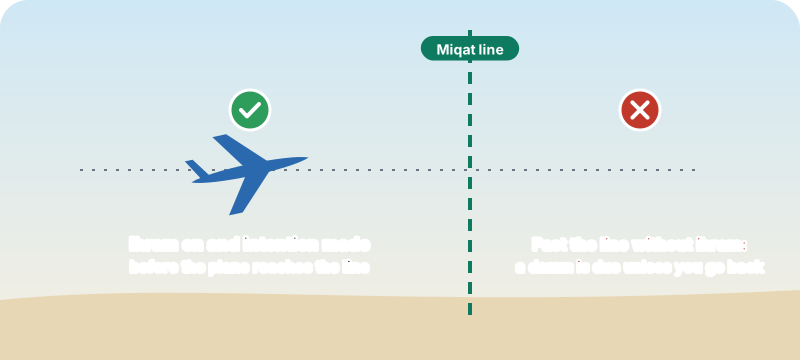
Say it straight after the intention; the two together begin ihram. Men raise their voices; women say it so they hear themselves.
Then repeat it often: after each prayer, when climbing or going down, meeting other pilgrims, getting into a car. Many say it three times each time.
For Umrah it continues until you begin tawaf.
Completa el hueco Until when?
In Umrah, the talbiyah carries on until you ______.
Ver la respuesta
Until you begin tawaf. In Hajj it carries on until the first pebble at Jamrat al-'Aqabah.
Lee
From this moment
Once you have said the talbiyah, you are a muhrim: a person in ihram. From now on, until your hair is cut:
- no perfume, and no cutting hair or nails;
- men: no shaped clothes, no covering the head or face;
- women: no cloth resting on the face;
- no marital relations, no hunting, no quarrelling.
The next lessons teach each rule and its penalty.
Ordena
Put entering ihram in order
Ponlos en el orden correcto.
- Nails, hair and a ghusl
- Put on the ihram clothes
- Pray two rak'ahs (if not a disliked time)
- Make the intention
- Say the talbiyah
Ver la respuesta
Clean up, dress, pray, intend, then the talbiyah. The intention joined with the talbiyah is the moment ihram begins.
Completa el hueco When does ihram begin?
Ihram begins with the intention joined to ______.
Ver la respuesta
Clothes alone do not begin ihram, nor do the two rak'ahs. The intention with the talbiyah (or another remembrance in its place) does.
Lee
A checklist for the miqat
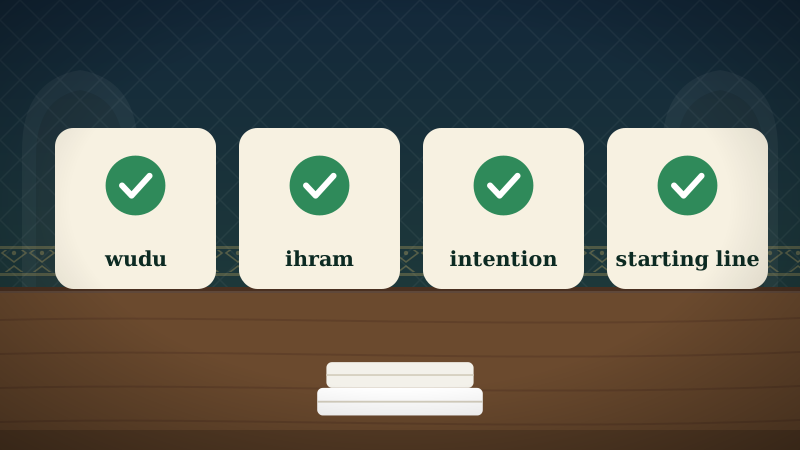
Use this at the miqat or on the plane:
- nails, hair and body hair done at home;
- ghusl or at least wudu;
- men in the two sheets, nothing shaped underneath; women in modest clothes, face clear;
- no perfume on the sheets or clothes;
- two rak'ahs, if it is not a disliked time and you are on the ground;
- the intention, then the talbiyah.
Tick all six and you are in ihram.
Elige The talbiyah aloud?
Who says the talbiyah aloud?
Ver la respuesta
Men raise their voices; women say it so that they themselves can hear.
Verdadero o falso The moment ihram begins
Ihram begins as soon as the white sheets are on.
Ver la respuesta
False. The sheets are only the dress. Ihram begins with the intention joined to the talbiyah.
Revelar
Mistakes at the start
Flip each card.
- The whole group chanting the talbiyah together Each pilgrim says their own. Chanting in one voice, led like a song, is not the sunnah.
- Women calling it out loudly Women say it softly, so they hear themselves.
- Intending in the heart but never saying the talbiyah Ihram needs the talbiyah, or another dhikr in its place, with the intention.
Lección terminada
Entering ihram, step by step
Has añadido un paso de la ruta a la ruta de un peregrino por La Meca, Mina y Arafa.
Lo que aprendiste
- Clean up and take a ghusl; perfume on the body, not the sheets.
- Two rak'ahs if it is not a disliked time.
- The intention, then the talbiyah: together they begin ihram.
- hechos
- 0
- bien a la primera
- 0
- para repasar
- 0
Tu obra · Pruébalo hoy
Learn the talbiyah by heart this week, a line a day.
Lo que guardaste
Inicia sesión para guardar tu progreso en todos tus dispositivos.