
0 محفوظ
ادخل المشهد
Bukhara, in today’s Uzbekistan
A boy in Bukhara
Blue domes in the evening light. A boy raised by his mother is about to start memorising more than anyone around him.
اقرأ
The boy with a huge memory
Bukhara, in today's Uzbekistan. A boy who lost his father young is raised by his mother. By his teens he has memorised thousands of hadith.
His mother made dua for him, and brought him up to love learning.
اقرأ
Muhammad ibn Isma'il al-Bukhari
Born in 194 AH (810 CE), he travelled for years across the Muslim world, from Makkah and Madinah to Egypt, Iraq and Syria, to hear hadith from their sources.
He died near Samarqand in 256 AH (870 CE).
خمّن
One book, how many years?
About how many years did al-Bukhari spend on his Sahih?
أظهر الإجابة
16 years About sixteen years, choosing only hadith with the strongest chains.
اقرأ
Sixteen years for one book
He spent about sixteen years writing his Sahih, choosing only hadith with the strongest chains.
Reports say he prayed two rak'ahs before adding each one.
Go deeper: how strict he was
He collected far more reports than he included, and only chose those whose every narrator was trustworthy and had met the one before. It is reported he prayed two rak'ahs before adding each hadith. Muslim scholars count his Sahih among the most reliable books after the Quran.
انظر
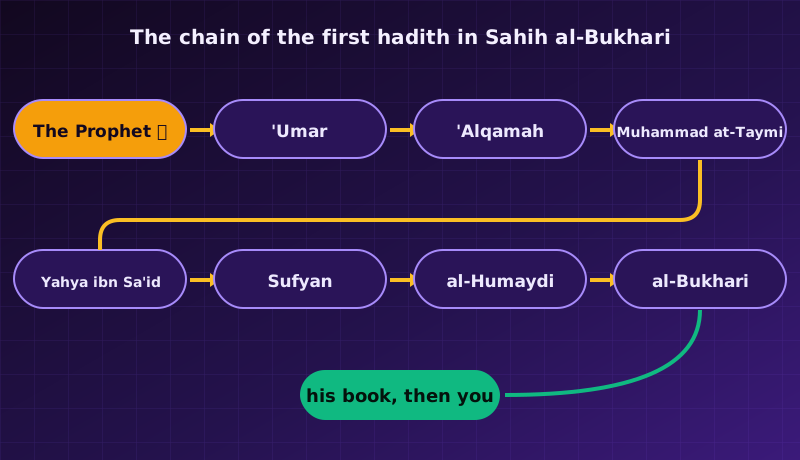
A chain of trust
من الحديث
The first hadith in his book
وعن أمير المؤمنين أبي حفص عمر بن الخطاب بن نفيل بن عبد العزى بن رياح بن قرط بن رزاح بن عدى بن لؤى ابن غالب القرشى العدوى. رضي الله عنه، قال: سمعت رسول الله صلى الله عليه وسلم يقول: " إنما الأعمال بالنيات، وإنما لكل امرىء ما نوى فمن كانت هجرته إلى الله ورسوله فهجرته إلى الله ورسوله، ومن كانت هجرته لدنيا يصيبها، أو امرأة ينكحها فهجرته إلى ما هاجر إليه" ((متفق على صحته. رواه إماما المحدثين: أبو عبدالله محمد بن إسماعيل بن إبراهيم بن المغيرة بن بَرْدِزْبَهْ الجعفي البخاري، أبو الحسين مسلم بن الحجاج بن مسلم القشيرى النيسابورى رضي الله عنهما في صحيحهما اللذين هما أصح الكتب المصنفة)).
'Umar bin Al-Khattab (May Allah be pleased with him), reported: The Messenger of Allah (ﷺ) said, "The deeds are considered by the intentions, and a person will get the reward according to his intention. So whoever emigrated for Allah and His Messenger, his emigration will be for Allah and His Messenger; and whoever emigrated for worldly benefits or for a woman to marry, his emigration would be for what he emigrated for"..
اقرأ
Why start there?
His book opens with this hadith on intentions, as if to say: check why you are reading this.
Every deed, even writing a famous book, starts with the intention.
رتّب The chain
Put the chain of the first hadith in order, from the Prophet ﷺ to al-Bukhari.
- The Prophet ﷺ
- 'Umar
- 'Alqamah
- Muhammad at-Taymi
- Yahya ibn Sa'id
- Sufyan
- al-Humaydi
- al-Bukhari
أظهر الإجابة
Eight links, each a trusted person who heard it from the one before.
صح أم خطأ True or false?
Al-Bukhari included every hadith report he heard in his Sahih.
أظهر الإجابة
False. He chose only a small part of what he collected, keeping just the reports whose every link was trustworthy.
اقرأ
Real talk: "says who?"
An isnad is a chain of named people who passed a saying on. Scholars checked every link: were they honest? did they remember well? did they really meet?
That is the best fact-checking system the pre-internet world ever built.
اكشف
Common mistakes
Think of the right answer first, then flip each card.
- "Hadith were made up long after the Prophet ﷺ." Scholars checked each chain carefully, name by name, and rejected what was weak.
- "If a hadith is quoted online, it must be in Bukhari." Many viral "hadith" have no source at all. Check before you share.
- "You need a perfect memory to learn." Al-Bukhari had one, but he also travelled, wrote and checked for years. Effort matters most.
صح أم خطأ Sixteen years
Al-Bukhari spent about sixteen years on his Sahih.
أظهر الإجابة
True. He took about sixteen years, choosing only hadith with the strongest chains of narrators.
+20 XP
Imam al-Bukhari
أضفت قرنًا إلى خريطة تتغيّر حدودها.
ما تعلّمته
- Al-Bukhari checked every link of the chain: always ask “says who?”.
- منجزة
- 0
- صحيح من أول مرة
- 0
- للمراجعة
- 0
عملك · جرّبه اليوم
Before you share a religious post today, check where it comes from.
ما حفظته
سجّل الدخول لتحفظ تقدّمك على كل أجهزتك.