
0 محفوظ
ادخل المشهد
A conversation
A hadith qudsi describes al-Fatihah as a conversation: the servant speaks, verse by verse, and Allah answers.
من الحديث
The prayer, divided
وَعَنْ أَبِي هُرَيْرَةَ قَالَ: قَالَ رَسُولُ اللَّهِ صَلَّى اللَّهُ عَلَيْهِ وَسَلَّمَ: «مَنْ صَلَّى صَلَاةً لَمْ يَقْرَأْ فِيهَا بِأُمِّ الْقُرْآنِ فَهِيَ خِدَاجٌ ثَلَاثًا غَيْرُ تَمَامٍ» فَقِيلَ لِأَبِي هُرَيْرَةَ: إِنَّا نَكُون وَرَاء الإِمَام فَقَالَ اقْرَأْ بِهَا فِي نَفْسِكَ فَإِنِّي سَمِعْتُ رَسُولَ اللَّهِ صَلَّى اللَّهُ عَلَيْهِ وَسَلَّمَ يَقُولُ: «قَالَ اللَّهُ تَعَالَى قَسَمْتُ الصَّلَاةَ بَيْنِي وَبَيْنَ عَبْدِي نِصْفَيْنِ وَلِعَبْدِي مَا سَأَلَ فَإِذَا قَالَ الْعَبْدُ (الْحَمد لله رب الْعَالمين) قَالَ اللَّهُ تَعَالَى حَمِدَنِي عَبْدِي وَإِذَا قَالَ (الرَّحْمَن الرَّحِيم) قَالَ اللَّهُ تَعَالَى أَثْنَى عَلَيَّ عَبْدِي وَإِذَا قَالَ (مَالك يَوْم الدّين) قَالَ مجدني عَبدِي وَقَالَ مرّة فوض إِلَيّ عَبدِي فَإِذا قَالَ (إياك نعْبد وَإِيَّاك نستعين) قَالَ هَذَا بَيْنِي وَبَيْنَ عَبْدِي وَلِعَبْدِي مَا سَأَلَ فَإِذَا قَالَ (اهْدِنَا الصِّرَاطَ الْمُسْتَقِيمَ صِرَاطَ الَّذِينَ أَنْعَمْتَ عَلَيْهِمْ غَيْرِ الْمَغْضُوبِ عَلَيْهِمْ وَلَا الضَّالّين) قَالَ هَذَا لِعَبْدِي وَلِعَبْدِي مَا سَأَلَ» . رَوَاهُ مُسلم
Abu Huraira reported God’s Messenger as saying, “If anyone observes a prayer in which he does not recite Umm al-Qur’an, it is deficient (he said this three times) and incomplete.” When someone asked Abu Huraira if he were led by an imam, he told him to recite it inwardly, for he had heard God’s Messenger declare that God most high had said, “I have divided the prayer into two halves between me and my servant, and my servant will receive what he asks.” When the servant says, “Praise be to God the Lord of the universe,” God most high says, “My servant has praised me.” When he says, “The Compassionate the Merciful,” God most high says, “My servant has lauded me.” When he says, “Possessor of the day of judgment,” He says, “My servant has glorified me.” When he says, “Thee do we worship and of Thee do we ask help,” He says, “This is between me and my servant, and my servant will receive what he asks.” Then when he says, “Guide us in the straight path, the path of those to whom Thou art generous, not of those with whom Thou art angry nor of those who go astray,” He says. “This is for my servant, and my servant will receive what he asks.” Muslim transmitted it.
اختر A conversation
In this hadith qudsi, what is al-Fatihah like?
أظهر الإجابة
The servant speaks verse by verse, and Allah answers each one. That changes how you say it.
من القرآن
Al-Fatihah 1 to 4
بِسْمِ ٱللَّهِ ٱلرَّحْمَٰنِ ٱلرَّحِيمِ﴿1﴾ ٱلْحَمْدُ لِلَّهِ رَبِّ ٱلْعَٰلَمِينَ﴿2﴾ ٱلرَّحْمَٰنِ ٱلرَّحِيمِ﴿3﴾ مَٰلِكِ يَوْمِ ٱلدِّينِ﴿4﴾
1 In the name of Allah, the Beneficent, the Merciful.
2 Praise be to Allah, Lord of the Worlds,
3 The Beneficent, the Merciful.
4 Master of the Day of Judgment,
انظر
The key words
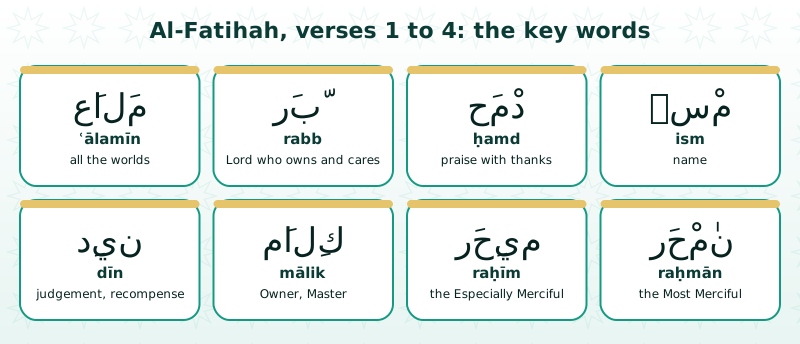
Ism, name; ḥamd, praise with thanks; rabb, Lord who owns and raises; ʿālamīn, all the worlds; raḥmān, raḥīm, mercy full and lasting; mālik, Owner; dīn, recompense.
The first half of al-Fatihah is praise. You are telling Allah who He is, and He answers.
المس المكان Tap the spot
Tap the word for Owner, Master.
أظهر الإجابة
Mālik: owner. In Hafs it is read with a long ā.
شاهد
Watch: the words you say in every rak’ah
كلمة كلمة
Word by word
- ٱلْحَمْدُ al-ḥamdu praise and thanks together · حمد
- لِلَّهِ lillāhi Allah, God: the proper name of the One God
- رَبِّ rabbi Lord: the one who owns, nurtures, provides for and cares for · ربب
- ٱلْعَٰلَمِينَ al-ʿālamīna world; in the plural 'alamin, all the worlds, all of creation · علم
Praise be to Allah, Lord of the Worlds,
اقرأ
Four ways of praising
Four verses, four ways of praising: His Name, as you begin; all praise and thanks, to Him; His mercy, full and lasting; and that He owns the Day of Recompense.
You tell Him who He is, and He answers.
Go deeper: the grammar
Bi-smi joins bi-, with, and ism, name. Al-ḥamdu lillāhi is a naming sentence: the praise belongs to Allah. Rabbi l-ʿālamīn joins two nouns: Lord of the worlds. Raḥmān and raḥīm are two patterns of one root, r-ḥ-m: mercy that is vast, and mercy that lasts.
صِل Match
Match the word to its meaning
- ḥamd praise with thanks
- rabb Lord who owns and raises
- ʿālamīn all the worlds
- mālik Owner, Master
- dīn recompense, judgement
أظهر الإجابة
Hamd is praise with thanks, rabb the Lord who owns and raises, 'ālamīn all the worlds, mālik Owner and dīn recompense.
استمع Listen and choose
Listen: which word do you hear?
أظهر الإجابة
Ad-dīn, with a kasrah and a long ī: recompense, as in the Day of Recompense. Ad-dayn, with a fathah, is a debt.
ابنِها
Build it
Order the first four verses by their key word
- ism (name)
- ḥamd (praise)
- raḥmān, raḥīm (mercy)
- mālik (Owner)
صح أم خطأ True or false?
Al-Fatihah’s first verses are praise, and its last verses are asking.
أظهر الإجابة
As the hadith of the divided prayer teaches.
اقرأ
For your life

Al-Fatihah in your prayer: it is wajib in the first two rakʿahs of a fard prayer and in every rakʿah of witr and voluntary prayers; in the last two rakʿahs of a fard it is Sunnah.
Praying alone, recite it yourself; behind an imam, listen silently. At its end, say Āmīn quietly.
اكشف
Common mistakes
Think of the right answer first, then flip each card.
- Racing al-Fatihah in one breath Pause at each verse end: He answers each one.
- Reciting al-Fatihah behind the imam The follower listens silently.
- Saying raḥīm with a light h Ḥa from the middle of the throat: raḥīm.
اقرأ
A moment for the heart

Next time you say al-ḥamdu lillāh in salah, remember: you are not speaking into silence.
You speak, and you are answered.
اكشف
In short
Answer each one in your head first, then tap to check.
- What is the first half of al-Fatihah? Praise: telling Allah who He is.
- What does mālik mean? Owner, Master.
- What does ad-dīn mean in al-Fatihah? Recompense: the Day every deed is repaid.
انتهى الدرس
Al-Fatihah, verses 1 to 4: praise
أضفت ركعة إلى سجادة تمتلئ ركعة بعد ركعة.
ما تعلّمته
- Al-Fatihah opens with praise: ḥamd, rabb, raḥmān, raḥīm, mālik.
- منجزة
- 0
- صحيح من أول مرة
- 0
- للمراجعة
- 0
عملك · جرّبه اليوم
At each of these four verses in your next salah, pause one heartbeat: He is answering.
ما حفظته
سجّل الدخول لتحفظ تقدّمك على كل أجهزتك.