
0 محفوظ
ادخل المشهد
A stranger in white
One day, as the companions sat with the Prophet ﷺ, a man in bright white clothes walked in. No sign of travel was on him, and nobody knew him.
انظر

He sat knee to knee with the Prophet ﷺ and asked questions that became one of the most famous lessons in Islam.
Later the Prophet ﷺ told them who the visitor was: the angel Jibril, come to teach them their religion.
من الحديث
The hadith of Jibril
عَنْ عُمَرَ رَضِيَ اللهُ عَنْهُ أَيْضًا قَالَ: بَيْنَمَا نَحْنُ جُلُوسٌ عِنْدَ رَسُولِ اللَّهِ صلى الله عليه و سلم ذَاتَ يَوْمٍ، إذْ طَلَعَ عَلَيْنَا رَجُلٌ شَدِيدُ بَيَاضِ الثِّيَابِ، شَدِيدُ سَوَادِ الشَّعْرِ، لَا يُرَى عَلَيْهِ أَثَرُ السَّفَرِ، وَلَا يَعْرِفُهُ مِنَّا أَحَدٌ. حَتَّى جَلَسَ إلَى النَّبِيِّ صلى الله عليه و سلم . فَأَسْنَدَ رُكْبَتَيْهِ إلَى رُكْبَتَيْهِ، وَوَضَعَ كَفَّيْهِ عَلَى فَخِذَيْهِ، وَقَالَ: يَا مُحَمَّدُ أَخْبِرْنِي عَنْ الْإِسْلَامِ. فَقَالَ رَسُولُ اللَّهِ صلى الله عليه و سلم الْإِسْلَامُ أَنْ تَشْهَدَ أَنْ لَا إلَهَ إلَّا اللَّهُ وَأَنَّ مُحَمَّدًا رَسُولُ اللَّهِ، وَتُقِيمَ الصَّلَاةَ، وَتُؤْتِيَ الزَّكَاةَ، وَتَصُومَ رَمَضَانَ، وَتَحُجَّ الْبَيْتَ إنْ اسْتَطَعْت إلَيْهِ سَبِيلًا. قَالَ: صَدَقْت . فَعَجِبْنَا لَهُ يَسْأَلُهُ وَيُصَدِّقُهُ! قَالَ: فَأَخْبِرْنِي عَنْ الْإِيمَانِ. قَالَ: أَنْ تُؤْمِنَ بِاَللَّهِ وَمَلَائِكَتِهِ وَكُتُبِهِ وَرُسُلِهِ وَالْيَوْمِ الْآخِرِ، وَتُؤْمِنَ بِالْقَدَرِ خَيْرِهِ وَشَرِّهِ. قَالَ: صَدَقْت. قَالَ: فَأَخْبِرْنِي عَنْ الْإِحْسَانِ. قَالَ: أَنْ تَعْبُدَ اللَّهَ كَأَنَّك تَرَاهُ، فَإِنْ لَمْ تَكُنْ تَرَاهُ فَإِنَّهُ يَرَاك. قَالَ: فَأَخْبِرْنِي عَنْ السَّاعَةِ. قَالَ: مَا الْمَسْئُولُ عَنْهَا بِأَعْلَمَ مِنْ السَّائِلِ. قَالَ: فَأَخْبِرْنِي عَنْ أَمَارَاتِهَا؟ قَالَ: أَنْ تَلِدَ الْأَمَةُ رَبَّتَهَا، وَأَنْ تَرَى الْحُفَاةَ الْعُرَاةَ الْعَالَةَ رِعَاءَ الشَّاءِ يَتَطَاوَلُونَ فِي الْبُنْيَانِ. ثُمَّ انْطَلَقَ، فَلَبِثْتُ مَلِيًّا، ثُمَّ قَالَ: يَا عُمَرُ أَتَدْرِي مَنْ السَّائِلُ؟. قُلْتُ: اللَّهُ وَرَسُولُهُ أَعْلَمُ. قَالَ: فَإِنَّهُ جِبْرِيلُ أَتَاكُمْ يُعَلِّمُكُمْ دِينَكُمْ . [رَوَاهُ مُسْلِمٌ]
Also on the authority of `Umar (ra) who said: While we were one day sitting with the Messenger of Allah (ﷺ) there appeared before us a man dressed in extremely white clothes and with very black hair. No traces of journeying were visible on him, and none of us knew him. He sat down close by the Prophet (ﷺ) rested his knees against the knees of the Prophet (ﷺ) and placed his palms over his thighs, and said: "O Muhammad! Inform me about Islam." The Messenger of Allah (ﷺ) replied: "Islam is that you should testify that there is no deity worthy of worship except Allah and that Muhammad is His Messenger (ﷺ), that you should perform salah (ritual prayer), pay the zakah, fast during Ramadan, and perform Hajj (pilgrimage) to the House (the Ka`bah at Makkah), if you can find a way to it (or find the means for making the journey to it)." He said: "You have spoken the truth." We were astonished at his thus questioning him (ﷺ) and then telling him that he was right, but he went on to say, "Inform me about Iman (faith)." He (the Prophet) answered, "It is that you believe in Allah and His angels and His Books and His Messengers and in the Last Day, and in fate (qadar), both in its good and in its evil aspects." He said, "You have spoken the truth." Then he (the man) said, "Inform me about Ihsan." He (the Prophet) answered, "It is that you should serve Allah as though you could see Him, for though you cannot see Him yet He sees you." He said, "Inform me about the Hour." He (the Prophet) said, "About that the one questioned knows no more than the questioner." So he said, "Well, inform me about its signs." He said, "They are that the slave-girl will give birth to her mistress and that you will see the barefooted ones, the naked, the destitute, the herdsmen of the sheep (competing with each other) in raising lofty buildings." Thereupon the man went off. I waited a while, and then he (the Prophet) said, "O `Umar, do you know who that questioner was?" I replied, "Allah and His Messenger know better." He said, "That was Jibril. He came to teach you your religion."
اقرأ
Three questions, three levels

In this hadith Jibril asked about Islam, then iman, then ihsan, and the Prophet ﷺ answered each in turn.
The order teaches something. Islam is the practice anyone can see. Iman is the belief inside it. Ihsan is the quality that makes both beautiful. Many new Muslims grow from the outside in: they begin by praying, and find their iman deepening through the prayer.
اعثر عليها
Three circles
Explore the picture: find all 3 points.

- Islam: what you do The five pillars: the Shahadah, salah, zakat, fasting in Ramadan and Hajj for those able.
- Iman: what you believe The six beliefs: Allah; the angels; the revealed books; the messengers; the Last Day; and Allah's decree of all things.
- Ihsan: how you worship Excellence: worshipping Allah with your full attention, knowing that He is always watching you.
انظر
Body, mind and heart
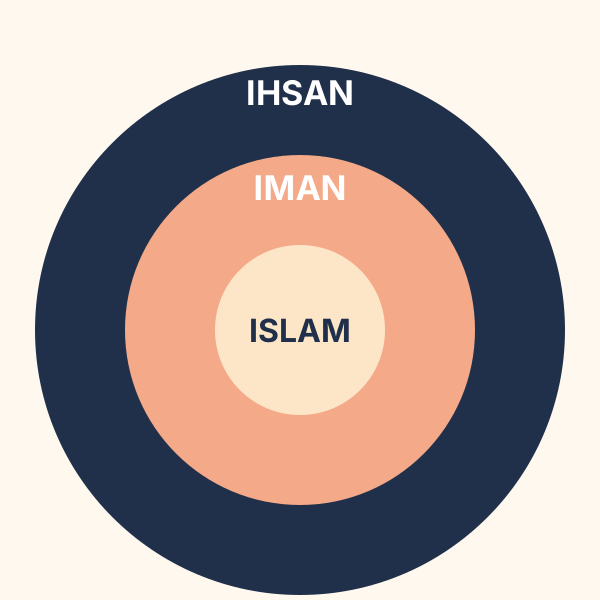
Islam is what your body does: praying, fasting, giving. Iman is what your mind and heart believe. Ihsan means excellence: the feeling, in the middle of an ordinary prayer, that Allah is watching you with love.
A new Muslim starts with Islam and iman, and grows into ihsan over a lifetime. Nobody arrives there in a week.
اقرأ
The five pillars of Islam

- Shahadah: the testimony you have already made.
- Salah: five prayers a day.
- Zakat: 2.5% of savings above the nisab, held a lunar year.
- Fasting: the month of Ramadan.
- Hajj: once in a lifetime, for those able.
These are the outward frame of Islam. You have raised the first already.
Go deeper: not all at once
Salah is due on you now. Fasting comes when Ramadan comes. Zakat is due only if your savings reach the nisab and stay above it for a lunar year. Hajj is due once you are able: healthy, with the means and a safe way. So most new Muslims start with the first two, and meet the others as they become due.
صنّف
Which circle?
Sort each card: Islam, or Iman, or Ihsan?
Islam
- Fasting in Ramadan
Iman
- Believing in the Last Day
- Believing in the angels
Ihsan
- Praying calmly, aware that Allah sees you
بطاقات
The six beliefs of iman
اقرأ
Belief in qadar, calmly

The sixth belief is in qadar: that Allah knows and has decreed all things, the good and what seems bad.
This is not fatalism. You still choose, plan and work, and you are asked about your choices. Qadar is what lets you do your best and then rest. The exam result, the job, the illness are in Allah's hands, and none of it is outside His knowledge or His mercy.
Go deeper: choices and decree
You choose, and you are answerable for your choices; nothing happens outside Allah's will. Hold both. Scholars advise new Muslims to leave the deep debates on qadar for later, when their foundations are firm.
من الحديث
The branches of faith
-وعن أبى هريرة رضي الله عنه، أن رسول الله صلى الله عليه وسلم قال: “الإيمان بضع وسبعون، أو بضع وستون شعبة، فأفضلها قول لا إله إلا الله، وأدناها إماطة الأذى عن الطريق، والحياء شعبة من الإيمان” ((متفق عليه)) .
Abu Hurairah (May Allah be pleased with him) reported: Messenger of Allah (ﷺ) said, "Iman has sixty odd or seventy odd branches. The uppermost of all these is the Testimony of Faith: 'La ilaha illallah' (there is no true god except Allah) while the least of them is the removal of harmful object from the road. And shyness is a branch of Iman."
اقرأ
Seventy branches

In this hadith iman is like a great tree with many branches. The highest is the testimony you have already said. The smallest is moving something harmful off a path so nobody trips. Even modesty is a branch.
So iman is not only in the masjid. Picking up broken glass on the pavement, or holding back a crude joke, is part of it too.
اختر Check your understanding
Which describes ihsan?
أظهر الإجابة
Ihsan is about the quality of worship: being aware that Allah sees you. Zakat belongs to Islam and belief in the books belongs to iman.
صح أم خطأ A sin and your iman
A believer who commits a major sin stops being a believer.
أظهر الإجابة
False. The scholars of Ahl as-Sunnah teach that a sin, even a major one, does not take a person out of iman. It is a sin to repent from. Rejecting the faith, or shirk, is what does that.
اكشف
Common mistakes
Flip each card.
- "Iman is only a feeling." Iman is belief in the heart, affirmed with the tongue, and it shows in deeds. Feelings rise and fall; belief stays.
- "Ihsan is only for scholars and saints." Ihsan is for every Muslim. One calm rak‘ah, aware that Allah sees you, is ihsan.
- "If I cannot do all five pillars, I am not Muslim." Do the pillars that are due on you. The others come when they become due.
- "Qadar means my choices do not matter." You choose and you are answerable. Qadar means nothing is outside Allah's knowledge.
فكّر في الأمر
Pause and think
When did you last feel that Allah sees you? Write about the moment, and what it changed.
لا يراه أحد غيرك، ويُحفظ على هذا الجهاز.
اقرأ
Ihsan at work and at home
Ihsan is not only for the prayer hall. Islam asks for excellence in everything you do.
For you that may be cooking well for your family, answering an email with care, or driving patiently. Doing a thing beautifully because Allah sees it turns ordinary work into worship.
اكشف
In one line
Sum up the lesson in your own words first, then tap to check.
- The lesson in one line Islam is what you do, iman is what you believe, and ihsan is doing it beautifully, as if you see Allah; each one grows the others.
انتهى الدرس
Islam, iman and ihsan
أضفت شعاعًا من النور إلى شروق يزداد إشراقًا درسًا بعد درس.
ما تعلّمته
- منجزة
- 0
- صحيح من أول مرة
- 0
- للمراجعة
- 0
عملك · جرّبه اليوم
In your next prayer, try ihsan for one rak‘ah: pray it as if you see Allah, knowing that He sees you.
ما حفظته
سجّل الدخول لتحفظ تقدّمك على كل أجهزتك.